 Pirsook Gallery
As I considered different approaches to this show, I kept coming back to a poem:
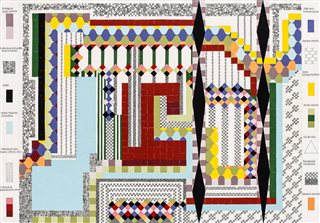
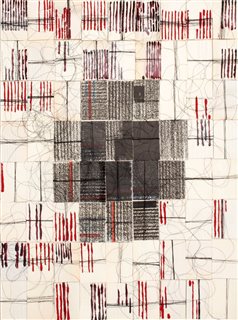
Wisława Szymborska’s The End and the Beginning. It became the starting point for the exhibition, bringing together the works of the following six artists: Niusha Baraei (b. 1998 Urmia), Afshan Daneshvar (b. 1972 Tehran), Nargess Hashemi (b. 1979 Tehran), Reza Lavassani (b. 1962 Tehran), Razieh Sedighian (b. 1986 Tehran) and Arya Tabandehpoor (b. 1985 Tehran). The poem begins in the aftermath of war, but its attention quickly shifts away from the event itself and toward what follows. Szymborska doesn’t dwell on destruction so much as on the labor that comes after it: someone has to clean up, someone has to remember, someone has to repair and someone has to forget and begin again. It is about the slow, often invisible work through which the world is made habitable again. What the poem offers is a way of thinking about what these works share: labor as a visible presence, and the way fragments, marks and small repeated actions accumulate into something whole. The works in this exhibition are not about war, and most were made before the events of recent months. Bringing them together; however, allows for a particular reading of them. Perhaps this is also why I kept returning to Szymborska’s poem—not because it explains the works, but because its attention to what happens between a beginning and an ending feels particularly close to where we find ourselves now. Daily life has resumed, yet something remains unresolved. The familiar structures of work and routine continue against a sense of interruption that has not entirely passed. We are somewhere between what has happened and whatever comes next, and it is from within this uncertain space that I have been looking at these works. In the works on display, the process is not concealed by the finished object; it is carried within it. There are hours of returning to the same surface, repeating a gesture, adding and removing, arranging one element after another. In some works, this accumulation is immediately apparent; in others it reveals itself more slowly. But in each, time and labor have become part of the work itself. This is what brings me back to the poem. Szymborska writes about the work that happens after something has ended but before what comes next can properly begin. You clean, repair, rebuild, return to things because there is little else to do but continue. Making can occupy a similar space. It asks for attention before there is any guarantee of where that attention will lead. Perhaps this is what feels most significant to me about these works now. They do not offer an answer to the uncertainty around us, nor do they need to. What they make visible is something much more modest: the decision to keep attending to something, to return to it, to spend time with it, and to continue making even when the larger picture remains unclear. In Between is not only the space between an ending and a beginning, but the time we inhabit while neither is fully within sight.
- Orkideh Daroodi
August 2026