 yafteh Gallery
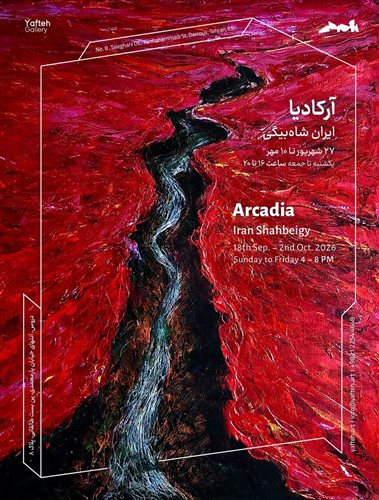
Iran Shahbeigi’s paintings appear as an attempt to rethink the concept of landscape. Here, landscape is no longer merely the representation of nature or the recording of an external vista; rather, it is transformed into a psychological, corporeal, and ontological domain. In these works, nature does not emerge as a tranquil and controllable reality, but instead exists in a state of transformation, turbulence, and instability. Earth, sky, fissure, flow, rock, and fire function less as descriptive elements of a specific geography than as signs of concealed and conflicting forces - forces that operate simultaneously within the inner layers of both the world and human experience.
The predominance of reds, oranges, and purples situates the atmosphere of the series within a field suspended between turbulence, violence, birth, and destruction. Here, red is not merely a sensory or decorative color; it acquires a conceptual quality and occupies the pictorial surface as a living, fluid substance. At times it evokes fire, at others a wound, an eruption of energy, or a sign of the world's state of crisis. In contrast, the presence of darker and cooler patches functions as a counterweight, making possible a kind of duality between collapse and continuity, death and genesis, closure and openness.
One of the significant aspects of this body of work is the tension between representation and abstraction. The paintings begin with familiar signs of nature, yet, in the course of their formation, gradually distance themselves from direct representation and enter a territory between recognizability and ambiguity. The forms still retain the capacity to refer to the external world, but they no longer obey the logic of classical landscape painting. Landscape here is not a window onto the world, but an active and self-sufficient surface - a surface upon which the image is simultaneously constructed and dismantled.
The fundamental dynamism of these paintings arises from the movement of the brushwork and the fluid organization of color. Brushstrokes, scratches, layers, dissolutions, and the overt encounters of color are not merely technical devices; they actively generate the work's meaning. In this series, paint
does not serve as a transparent and neutral medium, but becomes the very subject of the work. Color is not something that merely covers the surface; it is a force that constructs, erodes, and reconstructs it. Consequently, the canvas acquires a sedimentary quality, as though the image had emerged through the accumulation of time, pressure, resistance, and repeated returns.
In these works, painting functions as a field of struggle between control and release. On the one hand, there are signs of composition, visual direction, and the guidance of the viewer's gaze; on the other, the free - and at times explosive - movement of color continually threatens this order. The structure of the image never reaches complete stability but remains perpetually susceptible to opening, rupture, and collapse. This instability transforms the visual experience into a temporal one. The viewer is confronted not only with a finished image but also with the traces of its process of formation and transformation.
This body of work conceives nature as a body - a body that is wounded, split open, burned, and set into motion, while at the same time retaining the capacity for self-renewal. In this reading, the earth is no longer the neutral backdrop against which events unfold, but assumes the character of an active and vulnerable entity. Nature here is not a romantic image of serenity but a terrain of crisis and resistance, where destructive and vital forces are inseparably intertwined. It is precisely this perspective that distances the works from mere landscape painting and endows them with an ethical and distinctly contemporary dimension.
The overall atmosphere of the paintings may also be understood in relation to the concept of the threshold: the threshold between earth and sky, surface and depth, light and darkness, stillness and eruption, and reality and imagination. These works occupy a liminal position and resist the stabilization of any single meaning. The viewer encounters a world in which every form can simultaneously signify both ending and beginning, every fissure can be both a site of rupture and a possibility of passage, and every eruption can be both a sign of destruction and the emergence of a new force.
From this perspective, the series may be regarded as a visual narrative of a world in a continual state of becoming - a world that is unfinished, unsettled, and perpetually undergoing transformation. Rather than offering definitive answers about nature or the human condition, these paintings place the viewer before a sensory and mental experience - one in which the image is felt before it is seen. The
significance of these works lies precisely in this transformation of landscape into an inward experience. Nature speaks here in the language of anxiety, memory, desire, violence, and hope.
Ultimately, this series may be understood as a form of materially driven, process-based painting, in which landscape serves as a metaphor for the contemporary condition of existence. The world it depicts is neither tranquil nor readily interpretable; rather, it is a world in which meaning emerges through the interaction of forces, the accumulation of layers of paint, and the resistance of surfaces. These paintings stand at the threshold between destruction and continuity, demonstrating that even in the most intense states of turbulence and disintegration, the possibility of formation, regeneration, and persistence remains embedded within the very materiality of painting.