 IranShahr Gallery
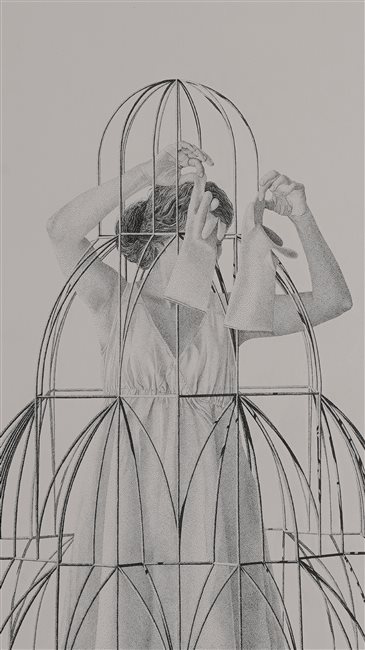
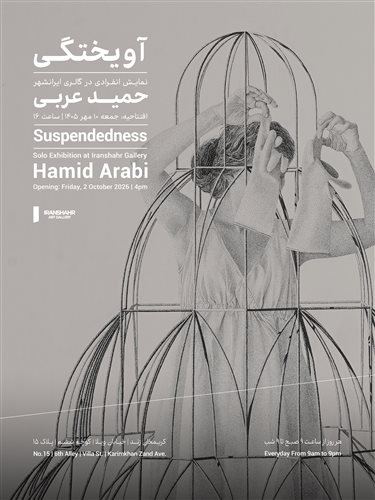
Each work begins from a point that, by itself, has no meaning at all. The dots settle on the surface one by one, with a patience close to ritual, so that in their thousandfold accumulation a form may emerge out of the heart of formlessness. In Hamid Arabi's work, stippling is as if a conversation between the artist and matter: each dot is a question that is put down, and matter gives its answer.
The material of these works is the past. The scenes and figures borrowed from classical painting and architecture are neither recreated nor left untouched; they are raw matter, like the palimpsest tradition: writing upon a surface that has already been written on, without the trace of the underlying layer being effaced.
The works are not narrative, and the bodies do not represent anything; they are the border between presence and absence. The frames lie in the moment before becoming or after it: Neither fully born, nor fully having completed a document of the past. As if each work were part of a larger canvas. In many of the figures the head is concealed beneath an architectural volume, a conical hat or a domed cage that both covers and confines. Perhaps the covering of the head takes away the possibility of having an identity.
Only the hand remains bare: a white glove on which a red colour has settled, dripping from its fingers; a border between inside and outside, between protection and harm.
What sets these works side by side is suspension, not as stillness but as a continuous in-betweenness between what has been and what is not yet. Doubt, in this body of work, is not a flaw but a method; the image takes shape not from certainty but from a repeated question.
— Pariya Ferdos[se] | Project Artistic Director