 Mellal Gallery
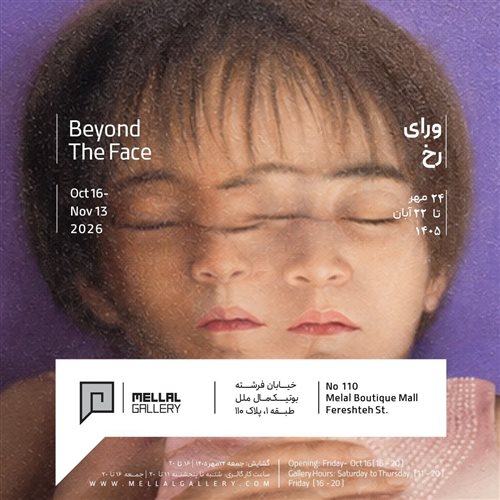
A portrait gives form to a relationship among four elements: an artist who looks, a subject who is placed under the artist’s gaze, an artwork that holds the result of this encounter, and a viewer who stands before it at a later time.
The arrangement of these four elements determines who is seen, who looks, and the nature of the encounter between them.
This exhibition seeks to trace the evolution of these relationships across three distinct moments in the history of Iranian visual art, from the tradition that took shape around Kamal-ol-Molk to contemporary art, and to show how each transformation in their arrangement redefines the viewer’s position.
The structure of the exhibition draws on the logic of a three-act play, for theatre, too, is a way of organizing the gaze.
Someone occupies the position of being seen, someone sits to watch them, and the rules governing these positions can change from one act to the next.
Here, all four elements remain present throughout the exhibition. What changes as the acts unfold is the viewer’s position among them and the nature of their encounter.
Act I: Distance
The School of Fine Arts, established in Tehran in 1910, pursued a mode of portraiture shaped by the Qajar court and European art academies. In encountering these works, the viewer is presented with an image that stands before them as a complete form, one that has reached its full realization before the viewer arrives. In this act, the viewer occupies the position furthest removed from the other three elements and engages in the recognition of the face.
Act II: Dialogue
Within the modernist experience, the previous arrangement of these elements becomes open to transformation. The artist and the artwork enter into dialogue with the viewer. The likeness of the face may remain legible, yet the process through which the image is constructed also becomes part of what is presented to the viewer. The artist’s presence is felt in the choice of visual sources and in the manner in which the face is rendered; the viewer, in turn, encounters an image that carries the traces of these choices. Meaning takes shape in the interval between the artist’s decisions and the understanding the viewer constructs from them. In this act, the viewer turns to interpretation, setting the image in motion anew through the process of reading it.
Act III: Presence
In the works of contemporary artists, the viewer’s act of looking enters the field of encounter. Distance, scale, surface, and reflection bring the viewer’s perception and feelings into the field of vision; other viewers, too, become visible as they look, becoming part of the experience and interpretation of the work. The viewer’s pauses, memories, and experiences contribute to the formation of the work’s meaning; at the same time, the material presence of the artwork, the subject, and the artist’s decisions retain their weight and significance. The viewer now finds themselves among those who can themselves be seen. The portrait is experienced in relation to an act that, until this point, may have seemed self-evident: looking. In this way, the encounter with the face expands into an encounter with the very condition of being a viewer.
The exhibition ends at the very point where it began: a face, and a person standing before it.
The viewer who leaves the exhibition has passed through three different arrangements of a single encounter. Perhaps they can now recognize the relationship within which they, too, have stood from the very beginning.
Amin Pouramin