 +2 Fereshteh (Sam Center)
One of the most prolific and conceptually fluid artists of his generation, Mohammad Fassounaki (b. 1943) grew up in a well-established family in Tabriz and began his artistic education with music. He first began his studies at Tabriz Music Conservatory, but while music has remained one of his most beloved mediums, he soon shifted his studies to visual arts. Leaving the conservatory, he was admitted into the Mirak Fine Art School where he studied until 1965.
After graduating, Fassounaki decided to move to Europe to continue his studies. He arrived in Germany in 1967, when he was still in his twenties at a moment when student movements and political unrest were transforming European cultural life. For him, Europe offered an encounter with modern art, but also a new sense of freedom within.
He studied painting at the Städelschule in Frankfurt, before moving to Italy to continue his education at the Accademia di Belle Arti in Rome. There, Fassounaki started a series of fresh explorations in different mediums, including printing and sculpture. These led to a deeper fascination with sculpture-making, inspiring him to enroll in the sculpture program at the Academy after his graduation in painting.
In 1974, Fassounaki returned to Tabriz and began teaching at Mirak, the school where he had once studied.
His students gradually became part of the history of his work. The studio became part of the way his work was transmitted.
Following the 1979 Revolution and the breakout of the Iran-Iraq War, Fassounaki moved away from teaching at Mirak and resigned in 1981. In 1984 he left again for Berlin. But Fassounaki's movements between Iran and Europe never produced a clean break. He returned, and Tabriz remained the place to which his work repeatedly led him back. It was also the place from which many of his images and inspirations seem to come.
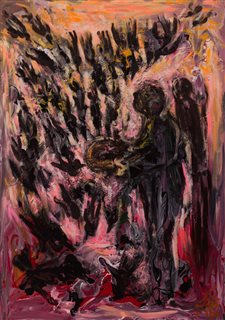
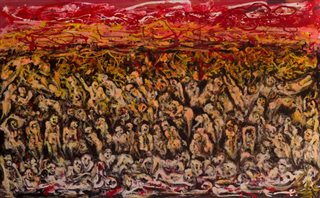
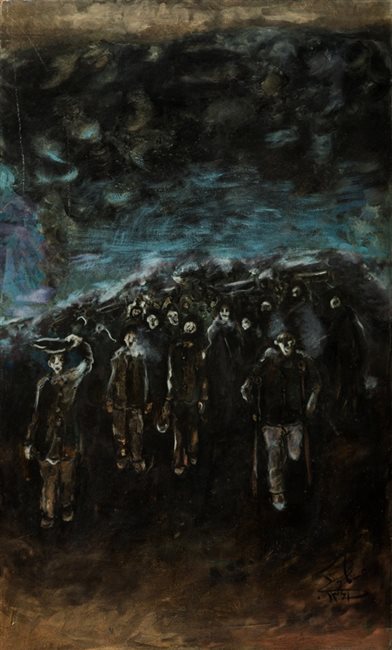
His paintings are full of people he appears to have carried with him. Faces occur everywhere, sometimes singly, sometimes in groups, sometimes almost hidden inside the paint. They do not resemble portraits in the conventional sense. He is interested in the people he encounters, but not necessarily in recording their exact appearance. A face might remain in his memory as an arrangement of eyes, a particular expression, the shape of a head, the color of a coat. When it reaches the canvas, it has already passed through memory.
This is why the people in his paintings can look familiar without being identifiable.
Now in his eighties, Fassounaki has remained as prolific as ever, continuing to work on his paintings and sculptures and exhibiting his work. His work does not resolve his different experiences into a single conclusion. Memory, observation, material and lived experience remain entangled. Fassounaki does not elaborate or explain; he remembers, creates, and exposes.
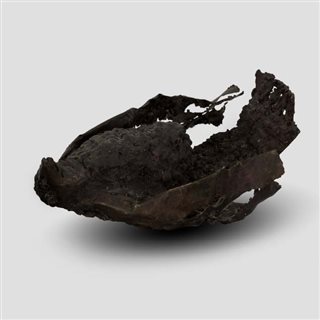
"Pulse; Resonance, and Descent" brings together a diverse set of works from distinct periods of Fassounaki's practice. The exhibition aims to encourage a dialogical reading of the works and a gradual movement between the artist's subjects and inspirations. In this sense, it pursues a study of both the work and the life that produced it, following recurring interests in people, faces, rituals, animals, landscape and everyday surroundings, while also looking at the changes that took place during Fassounaki's travels and relocations.
When Fassounaki speaks about his years in Tabriz, he recalls being observantly attentive to the people around him, their rituals, activities reserved for particular times of the year, the religious ceremonies, winter, buying fruits in summer. This careful watch of people and those recurring events gave him a sense of how closely people's lives could be connected to a place, and custom, and therefore, probably how traditions and rituals form. Portraits emerged from the same attention, as it continued to his years abroad.
During his early years in Germany, due to his relative unfamiliarity with the language, his interest in faces and expressions got meticulously more concentrated. He searched their body language and gestures to understand their words. Such deep exploration and interest became increasingly inspiring for the artist to continue his studies on human faces and expression throughout his career. In the words of Nader Tabassian, "the difference among [the] faces lies not in their geometric appearance, but rather in the distinction of each individual portrait through variations in life, thought, pain, suffering, and the essential core of the subjects' lives."
This attention to people was not limited to portraiture. It extended into the spaces they occupied and the objects, animals and landscapes that surrounded them. These subjects appear throughout Fassounaki's work as things he encountered and observed, each becoming the focus of his attention for a period of time before another subject took its place. The subject emerges, deepens and settles, before giving way to the next. This movement from one subject to another forms a sustained pattern throughout Fassounaki's work.
The artist's unique perspective into his subjects causes a blending of emotions, times and places and a dynamic expression of long-term impressions and inspirations. As Tabassian puts it,
"Fassounaki emphasizes that the subject in painting is his last priority. But the truth is that if he were not strongly affected by the subject, he could never move the viewer with his emotion in this way... Unconsciously, Fassounaki gives immense weight to the subject, carrying a world of memories for each and every one of his portraits."
Ultimately, it is by the force of inspiration that the work persists through the layers of time, space and memory. As Sa'ed Meshki notes, "In the presence of Mohammad Fassounaki's works, without even realizing it, we are awestruck by his expression; we are overcome by the feeling he transmits to us through his canvases. These works, like any other pure creation, are communicated to us from within and through his pure emotion."
"Pulse; Resonance, and Descent" could not be realized without the generous support of Amir Yeganeh, as well as the help of Ali Ghassemi, and Nazar Publication House. The exhibition will be on view from August 21 to September 11, 2026, at +2 [Sam Center].