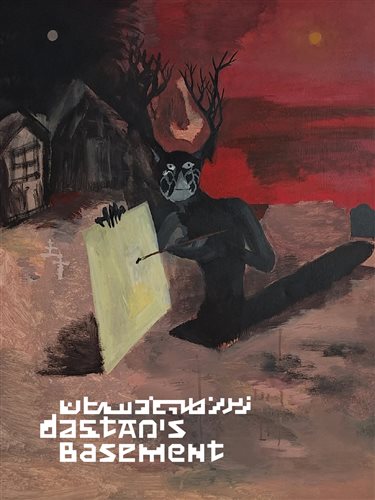
 Dastan's Basement
Artist Overview:
It is not often, in the present moment, that one hears an artist is making religious art, without irony, and rarer still when the work that follows remains inviting rather than doctrinal. Sadra Baniasadi another painter-prophet, alike to Mani, has the patience of someone who has accepted the burden of a narrative role rather than the comfort of a novel pioneer.
Born a Virgo in 1991, Tehran, into a family of artists, with both father (Mohammad Ali Baniasadi) and grandfather shaping his earliest sense of what it meant to paint, Sadra grew up within a quiet familiarity with images and their habits. During his studies at Tehran’s School of Fine Arts and later the University of Art his work was not welcomed academically, none of his teachers could stomach it, often warning him of ending up like his father; an illustrator. The narrative insistence of his work often met a restrained resistance, a friction that seemed less to divert him than to confirm the necessity of pursuing a more private and continuous path. Perhaps this was what drew him to take his images in a sticker format to the streets plastered over the city, forming a community with the outcast graffiti artists.
His work does not lay easily on a spectrum, if one could consider any, of representation and abstraction, but moves instead within a quieter territory where form yields to the pressure of story, as the likes of Giotto in the early Christian images, in their reliance on narrative over description. What appears is less a record of how a thing looks than an evocation of what it leaves behind in the mind, the remembered trace of an essence rather than its visible outline.
Sadra’s studio, crowded with devotional images of the Holy Mary, beads (Tasbīḥ), iconographic carpets of Imam Ali, and books on Indian Religions, suggests a research-based devotion to sources, yet the paintings resist the polished inevitability that often accompanies such preparation. The ease with which he absorbs these icons of other religions could have not satisfy his temptation for creating his own. This is where his private religion, with its mirrored gods of image and sound, of surface and air, begins to feel less like a system than a method, a way of thinking through painting rather than about it.
There is a certain quiet courage in this, a willingness to accept being dismissed as naïve, illustrative, or inopportune, and to continue nonetheless, guided by an interior rhythm that does not seek permission. The paintings do not demand belief from the viewer.
About Loneliness
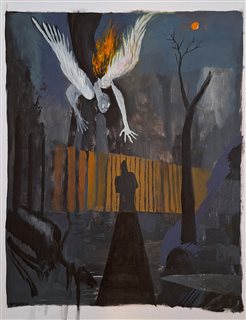
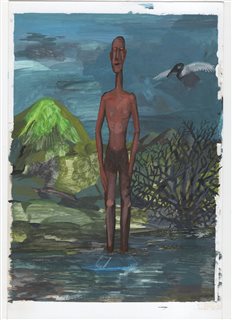
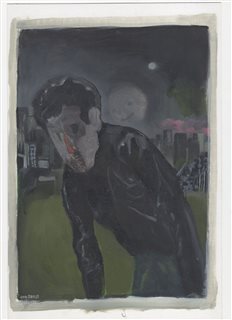
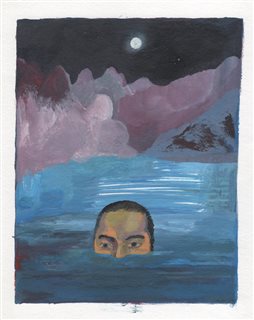
Loneliness is Sadra Bani Asadi's most recent body of work.
The series continues Sadra's engagement with mythology and theological imagery while turning toward themes of love, death, loneliness, and the experience of being alive. Mythology functions within these works not simply as subject matter, but as a framework through which emotional and existential conditions can be explored.
The series brings together several of the concerns that have appeared throughout Sadra's previous bodies of work, allowing earlier visual and conceptual elements to reappear within a new context.
The works consider emotions and conditions that exist beneath individual stories and mythologies, creating a space where personal experience, symbolic imagery, and broader human conditions intersect.
Exhibition Design
The exhibition design extends the conceptual structure of the paintings into the gallery space.
The visitor's journey is organized around the Seven Circles of Hell in Dante's Inferno. Seven painted curtains unfold across the gallery walls, each corresponding to one of the seven circles.
Rather than functioning as decorative elements, these curtains establish the exhibition's spatial rhythm and narrative progression. They create a symbolic passage through the space, allowing the works to be experienced as part of a continuous journey rather than as isolated objects.
The seven curtains are conceived in relation to the scale and structure of Dante's Inferno, translating its seven circles into a spatial and visual framework within the gallery.
A sound piece created by Sadra specifically for the exhibition, inspired by Inferno, accompanies the installation and contributes to the atmosphere of the space.
The titles of the paintings are hand-painted directly onto the walls in Persian Nastaliq calligraphy using black acrylic paint. Typography therefore becomes part of the exhibition's visual language rather than functioning as an external graphic element.
The exhibition design should not be understood as a literal visualization or reconstruction of Dante's Inferno. Instead, Dante's structure provides a conceptual architecture through which the emotional and narrative progression of the works can unfold.