 yafteh Gallery
The expansive world of Mahmoud-Reza Zandpour is a landscape of profound silence and eternal suspension, a space where the sublime and uncanny forces of nature intertwine with the rigid violence of artificial geometries. He invites us to observe a psychological geography that is less a representation of a specific place and more an embodiment of the human existential condition confronting macro-structures of power, isolation, and historical determinism. In his vast landscapes, framed by icy mountains, turbulent skies, wastelands, or dense forests, human figures appear not as autonomous agents, but as faceless, alienated, and uniform masses. These identical figures -whether marching in strict geometric formations toward unknown, monolithic structures, or wandering lost within deep ravines - are metaphors for subjugation, the loss of individual identity, and contemporary humanity’s herd-like drift toward an unknown destination.
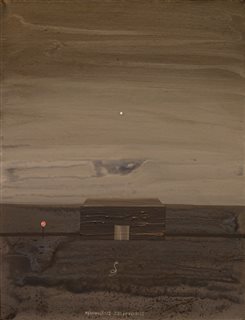
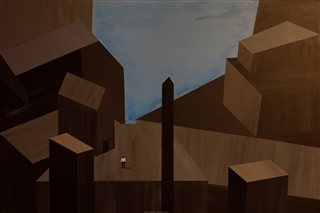
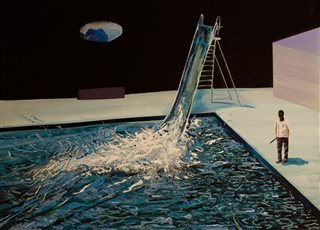
The fundamental tension in these works lies in the dichotomy between the mass and the observer, and between wild nature and geometric order. Cubic volumes, platforms, and brutalist structures - symbols of institutional power and control - are imposed upon the landscape, confining humans within their boundaries. The isolated presence of solitary figures atop roofs or platforms, contrasted against the fluidity of the masses, suggests a hierarchy of surveillance and alienation. The cold palette of grays and frozen blues, occasionally disrupted by streaks of warm color or a pure geometric form, creates the atmosphere of a timeless dystopia. Mahmoud-Reza’s paintings invite us to contemplate human solitude amidst the crowd, the anxiety of displacement before unknown forces, and our silent progression through history; a visual narrative of a shared dread hidden behind the silence of these canvases.
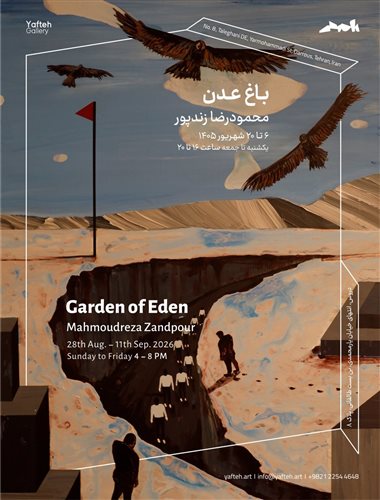
In Mahmoud-Reza Zandpour’s paintings, the viewer primarily encounters an experience of the Sublime, yet through a dark and contemporary lens. He creates a geography whose dimensions exceed the human scale, placing humanity before an expanse of massive unknowns, indifferent nature, and rigid structures. These paintings depict a fragmented yet continuous narrative of a migration, a collective ritual, or perhaps a historical exile. In this world, geography is not merely a backdrop but acts as a dominant and oppressive force itself. Icy mountains, deep valleys, dense forests, twilight skies, and birds of prey collectively forge an atmosphere of eerie anticipation and an inevitable end that casts a shadow over all elements of the canvas.
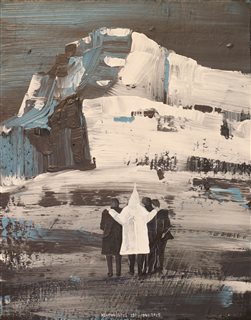
The concept of the mass and the crisis of individuality serve as the focal point of this collection. By deliberately omitting faces and individual traits, the artist creates uniform figures - sometimes in ritualistic cloaks, sometimes like wandering ghosts - arranged in highly ordered, geometric formations. This militaristic, herd-like order, which reduces the figures to components of a massive, unknown machine, evokes totalitarian structures and controlling systems in human societies. The movement of these masses toward monolithic cubes, dark gates, or rocky crevices does not appear to be an act of will, but rather a deterministic pull and a surrender to the allure of power or darkness. Here, humans are not living; they are passing through an endless purgatory.
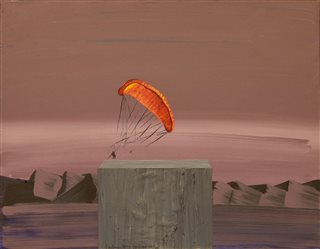
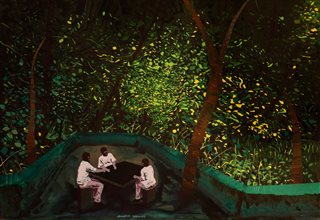
In contrast to these dense masses, the artist cleverly utilizes the element of isolation and surveillance. The elevated presence of solitary figures - on rooftops, cliff edges, or platforms - forms a duality of the observer and the observed, the controller and the controlled. This contrast injects a layer of modern surveillance anxiety and human alienation from one’s peers into the conceptual fabric of the works. Even in pieces dominated by dense foliage and organic forms, pure geometries (triangles and cubes) infiltrate nature as alienating interventions, signaling the conquest of space by an artificial and hegemonic force.
Aesthetically, the use of expressive and loose brushstrokes in the backgrounds is deliberately contrasted with ruled geometry and rigid architectural forms. A limited and cold color palette, built upon dark blues, cold grays, and muted whites, intensifies the sense of freezing and stasis, draining any vitality from the landscape. However, sudden lighting contrasts - such as the redness of a sunset or colored geometric forms within a chaotic forest - act as visual shocks that heighten the eeriness of the scene.
This collection is not merely a visual report of a dystopia; it is a psychological exploration into the depths of our collective anxieties. With a visual language that is simultaneously mythical and contemporary, the artist crafts a powerful metaphor for depersonalization, the loss of identity, and human disorientation within the labyrinth of history and power structures. These works compel us to stand within the heavy silence of the canvases and ask ourselves: in the irreversible path of the masses, where do we stand? Are we the observer standing on the roof’s edge, or one of the thousands of faceless figures advancing toward the darkness of a concrete cube?
Hamidreza Karami